
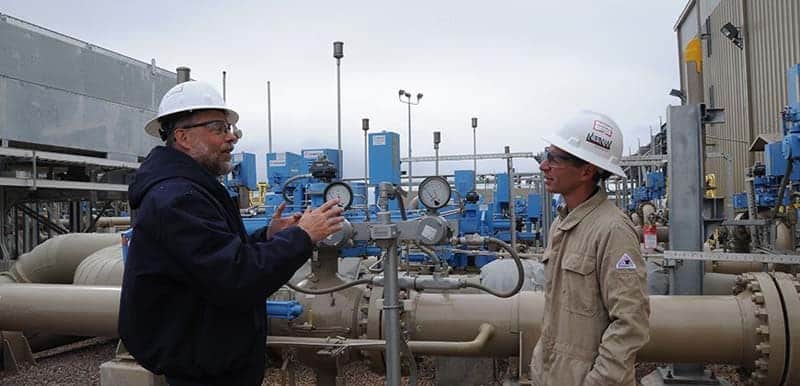
CSU Energy Institute researchers Dan Zimmerle and Anthony Marchese at a natural gas transmission station. They are starting a Department of Energy-supported field campaign to measure methane emissions from gathering compressor stations.
Natural gas, a clean-burning fuel, has significant potential as a “bridge fuel” on a path to a sustainable energy future. However, its climate benefits are highly dependent upon the emission rate of methane from the nation’s vast natural gas infrastructure.
Colorado State University, home to some of the world’s top researchers on methane emissions, will lead a major project to analyze emissions from a specific part of the natural gas supply chain: compressor stations. The new project will help scientists develop a more complete picture of overall emissions.
Methane is the primary component of natural gas and a powerful greenhouse gas with a global warming potential 84 times that of carbon dioxide over a 20-year time frame. Although atmospheric methane originates from many sources, no industry has received more scrutiny for emissions than the natural gas sector. Significant quantities of methane are emitted from its million-plus miles of pipeline, half million wells, and thousands of gathering, processing, transmission, storage and distribution facilities.
0 Comments