
 Cookie Cole, her face a portrait of grief and ire, flings toward the sky a handful of creek water.
Award-winning documentary filmmaker and photographer Marino Colmano of Blacksburg captured the moment.
Cole laments the risk that the proposed Mountain Valley Pipeline would pollute water precious to her farm in Monroe County, West Virginia. Colmano’s footage shifts into slow motion, and the creek water flung by Cole separates into drops that glisten in the air like tears.
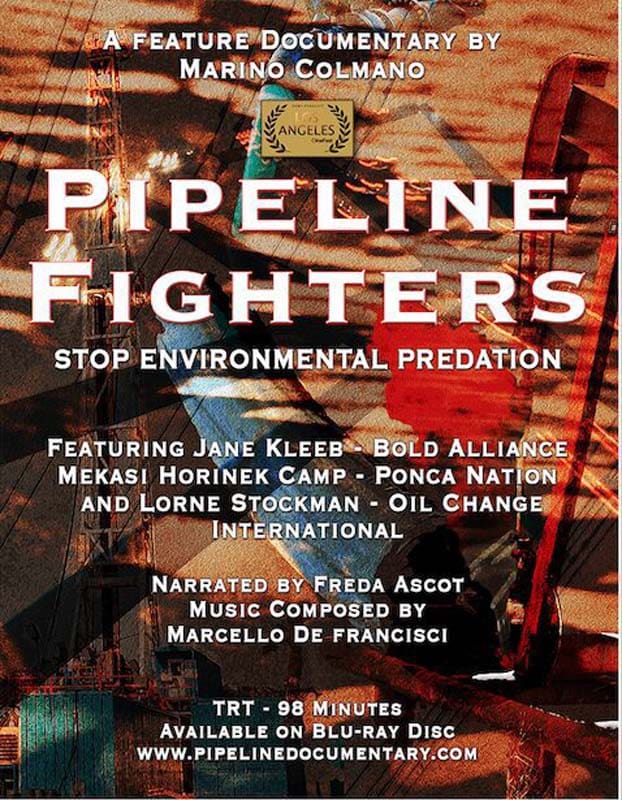
Colmano, 68, recently completed “Pipeline Fighters,” a 98-minute documentary that fuses testimonies of lamentation, defiance and resolve in a scathing examination of fossil fuel infrastructure projects, hydraulic fracturing, climate change and the use of eminent domain in the service of corporate profits. You can watch the trailer for the documentary on YouTube.
Colmano, a native of Italy whose filmmaking career included about three decades in Los Angeles, hopes the film will soon screen at regional independent theaters. He said he believes “Pipeline Fighters” — less polemical than a Michael Moore documentary but generally unencumbered by dissenting views — will be a call to action.
That action might become non-violent civil disobedience if pipeline projects proposed in Virginia proceed, said Rick Shingles of Giles County. Shingles, who is featured in “Pipeline Fighters,” was arrested in October during an anti-pipeline protest outside the governor’s mansion in Richmond.
The film’s predominant focus is opposition in Virginia and West Virginia to the proposed Mountain Valley Pipeline. And its primary sources are people like Cole — residents who express grief, anger and incredulity about the threats they believe the multi-billion dollar project poses to rural landscapes they consider sacred and lifestyles they hold dear.
“The main thrust of my work, from the start, has been about emotional content,” Colmano said in November.
The film, which Colmano began shooting in October 2014, also chronicles opposition to the separate but similar Atlantic Coast Pipeline, as well as to the Keystone XL and Dakota Access crude oil pipelines.
A key source is Jane Kleeb of Nebraska, dubbed the “Keystone Killer” by Rolling Stone magazine for her role organizing opposition to that pipeline.
‘Eminent domain abuse’
Kleeb is president of Bold Alliance, a network of groups fighting fossil fuel projects and “eminent domain abuse.” She has visited Virginia at least four times since April to share with anti-pipeline activists her experiences organizing grassroots campaigns.
Kleeb emphasizes that an unlikely alliance — a collaboration of ranchers, Native Americans and environmentalists — helped defeat the Keystone pipeline. One consensus uniting the groups was the conviction that private companies should not be able to acquire private property through eminent domain for private gain.
Both the Mountain Valley and Atlantic Coast projects have applied to the Federal Energy Regulatory Commission for the certificate required to begin construction. If FERC approves the pipeline, Mountain Valley Pipeline LLC will have access to eminent domain to acquire easements across private property.
The Mountain Valley project would bury a 42-inch diameter steel pipeline that would transport natural gas at high pressure through 11 counties in West Virginia and six in Virginia: Giles, Montgomery, Craig, Roanoke, Franklin and Pittsylvania.
“Pipeline Fighters” includes interviews with residents from a sampling of counties in both states.
David Seriff and Pat Tracy each live in the Preston Forest subdivision in Montgomery County and both appear in the documentary.
The comparatively affluent subdivision, whose residents include professors at Virginia Tech, was briefly in the crosshairs of a route for the Mountain Valley Pipeline.
In October 2014, Seriff hosted a meeting at his house after neighbors learned about the route. That’s when Colmano and Freda Ascot, 63, his partner in life and business since they met in Los Angeles in 2000, started work on “Pipeline Fighters,” which Ascot narrates and helped produce and shoot.
“When my neighborhood discovered that MVP wanted to put a pipeline through it, I didn’t expect 50 upset neighbors to show up in my living room to discuss the challenge,” Seriff recalled.
“On the spur of the moment, my friend Marino Colmano arrived with camera in hand and began filming,” Seriff said. “I knew that Marino had a background in the film industry but I had no idea that this would be the beginning of a series of episodes he would create to follow the fight against the pipeline.”
The documentary evolved from 25 episodes that Colmano and Ascot shot and posted periodically at pipelinedocumentary.com in the months and years that have followed the meeting at Seriff’s home.
Marino spent “thousands of hours and a great deal of his own money to create a riveting full-length documentary film” from the episodes, Seriff said.
Tracy said Colmano has covered “the pipeline resistance movement” since 2014 “at enormous cost of time and money to himself and Freda.”
In an email, Tracy added, “He has captured, in the powerful medium of film, the whole range of issues that are touched by this movement: from the global impact of fossil fuel extraction and use, the appalling collusion of government and corporations to devastate the natural environment for the sake of private profit, the severe danger to nationally protected forests and wide-spreading water source systems, to the anguish and economic ruin of so many property owners along the pipeline path.”
“Pipeline Fighters,” she said, “conveys the depth and breadth of the crisis we are facing.”
The documentary’s chronicle of pipeline resistance does not reference the stiff opposition in portions of Roanoke County to survey crews working for Mountain Valley. There are glimpses of Carolyn Reilly of Preserve Franklin County and of Mara Robbins, an early leader of pipeline resistance in Floyd County, but the majority of original footage in Virginia was shot in Montgomery and Giles counties.
Colmano acknowledged that limited resources precluded a comprehensive portrait of resistance along the full route of the proposed 303-mile pipeline.
From Bologna to Blacksburg
Marino Colmano was born in Bologna, Italy, in October 1948, one of three children born to Germille and Miranda Colmano.
The family moved to the United States in 1951 and lived in Denver; Madison, Wisconsin; Baltimore and Pittsburgh before moving in 1962 to Blacksburg, where Germille, a physiologist, became a Virginia Tech professor.
Colmano became interested in art and film as a boy. When the family lived in Pittsburgh, he said he was the only child enrolled in adult art classes at the Carnegie Institute.
Later, Colmano studied commercial art at Virginia Commonwealth University before enrolling at the San Francisco Art Institute, from which he graduated in 1972 with a degree in photography and film.
It was a heady time in San Francisco, where Colmano was a founding member in 1971 of Project Artaud, a pioneering artists’ community established in a former factory built by the American Can Co.
In 1979, after making a connection with actor Dustin Hoffman, Colmano moved to Los Angeles. His three decades there yielded 30 international film festival awards, Colmano said.
And he met Freda Ascot, born Aphrodite Askotiris in Greece.
“If there is such a thing as a soulmate, she is it,” Colmano said.
Art and commerce
A mix of circumstances, including health problems tied to a brain aneurysm and kidney cancer, and the deaths of his brother, Carlo, in 2004, and father, Germille, in 2006, motivated Marino to return to Blacksburg in 2009 with Ascot.
Interests in cooking and organic gardening led the couple in 2010 to found Harmony Organics, which they operate out of their home and film and photography studio on North Main Street in Blacksburg.
Colmano said the challenge he has embraced since his career began is how to mix art and commerce to survive as an artist.
He has submitted “Pipeline Fighters” to several film festivals. An earlier version was a semi-finalist in Los Angeles CineFest.
Colmano does not anticipate that the documentary will make a lot of money. He said a GoFundMe campaign, small donations from individual contributors and other funding has helped recover a major portion of the $20,000 he estimates he has spent through Lucid Media to shoot, produce, edit and distribute the film.
He shrugged.
“This is my way of giving back to the community,” Colmano said.
Shingles expressed appreciation.
“Marino and Freda have filmed the impact of the proposed MVP on our communities, our awakening and resistance, from the very beginning. It has been a Herculean task for which residents are deeply indebted to Lucid Media.”
For more information, go to pipelinedocumentary.com.
Posted: Sunday, January 8, 2017 6:00 pm
I wish this film was showing at the RVA Environmental Film Festival in early February