
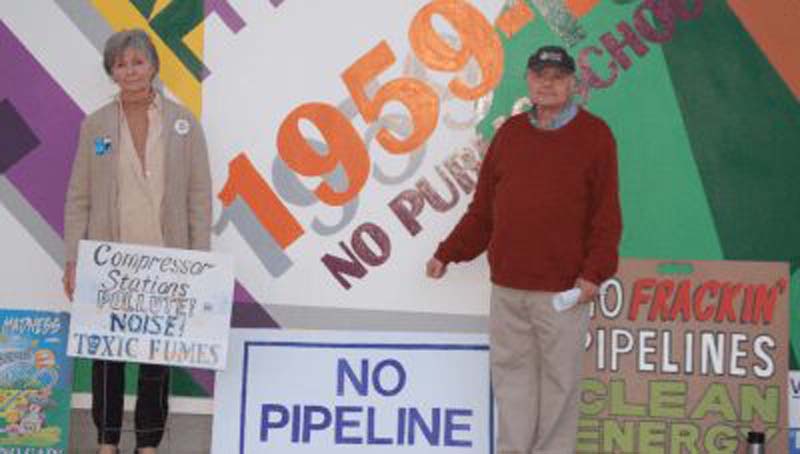
In protest of the proposed 600-mile Atlantic Coast Pipeline project, Friends of Buckingham’s Kenda Hanuman stands with The Sierra Club’s Kirk Bowers outside the Robert Russa Moton Museum in Farmville, where the Federal Energy Regulatory Commission held a public comment session Tuesday on a Draft Environmental Impact Statement.
More than 100 people attended the Federal Energy Regulatory Commission’s (FERC) public comment session at the Robert R. Moton Museum, held Tuesday, regarding a Draft Environmental Impact Statement (DEIS) on the proposed 600-mile Atlantic Coast Pipeline (ACP) project.
Of the 115 in attendance, 53 communicated during the event to FERC representatives about the DEIS — a study regarding the environmental impact that the natural gas pipeline will have on the communities it’s set to travel through.
Those who offered comments either spoke one-on-one with a FERC representative or submitted comments in writing during the event, according to federal officials.
The session was the fifth overall and second in Virginia, according to FERC spokeswoman Tamara Young-Allen, who cited 10 planned public comment sessions where those concerned could comment directly to FERC representatives.
Young-Allen said those who wish to comment can do so online, by mail or at one of the public comment sessions, noting the final DEIS will be available in June.
Those opposed and in favor of the pipeline, which is set to span Buckingham and cross parts of Cumberland and Prince Edward, made their opinions known at the session. Those opposing the ACP brought signs showing disfavor, leaning some against the museum’s exterior.
Danny Watson, the business manager of the Local 45 Chapter of the International Brotherhood of Boilermakers, said he supported the pipeline, citing jobs and the potential benefactor of facilities being built in the future.
“During construction, some of our members that live here in the state, and live out of the state will be employed from it,” Watson said. “The other factor we’re trying to push on is local jobs for local people (for) guys that live in the state.”
“I know the arguments here, but they just don’t make sense to me,” said Kirk Bowers of the Sierra Club — a group that’s been opposed the ACP since its inception. “They say they’re going to create more jobs in the area, but you could do the same thing with solar farms.”
Stephen Martin, of Cumberland, said during the event that renewable energy wasn’t efficient enough to warrant opposition to the pipeline.
“If Richmond depended on solar power, it would take 40,000 acres of solar panels to power the region, and that would probably be for only five hours a day,” he said at the museum. “The rest they’d be in the dark,” Martin said.
Martin said he believed in solar power, but it needed to be combined with other energy resources.
Farmville Herald/ Morgan White
0 Comments