
Massive tanks in Oklahoma brim with unrefined oil, but they weren’t designed to handle the rash of seismic activity caused by fracking-related activity.
When Hurricane Harvey made landfall in Texas, U.S. oil refining plummeted to record lows. Now, nearly three weeks later, six key refineries remain shut down and an additional 11 are either struggling to come back on line or operating at a significantly reduced rate. That slowdown, coupled with predictions of decreased demand in the wake of Hurricane Irma and the devastating earthquake that struck Mexico last week, has shifted oil pressures in other places, too. And none may be quite as vulnerable as the tank farms in Cushing, Oklahoma.
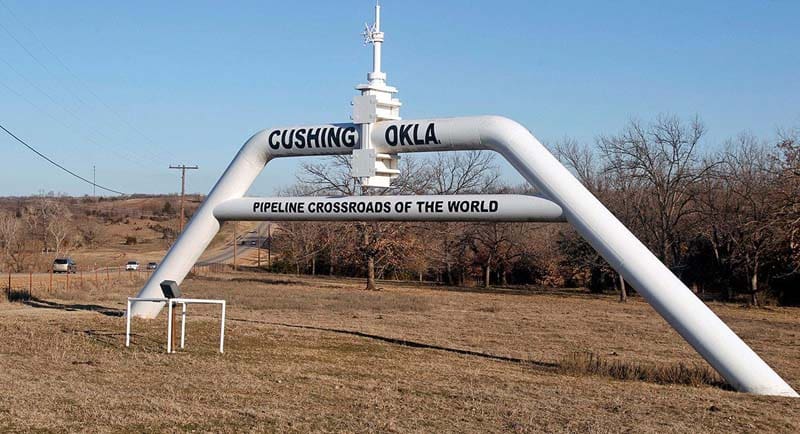
Dubbed the “Pipeline Crossroads of the World,” Cushing is the nexus of 14 major pipelines, including Keystone, which alone has the potential to transport as much as 600,000 barrels of oil a day. The small Oklahoma town is also home to the world’s largest store of oil, which sits in hundreds of enormous tanks there. Prior to this recent spate of natural disasters, Cushing oil levels were already high. They’ve increased nearly a million barrels, to nearly 60 million barrels, since Harvey hit.
This concentration of oil, about 15 percent of U.S. demand, is one reason the Department of Homeland Security has designated Cushing “critical infrastructure,” which it defines as assets that, “whether physical or virtual, are considered so vital to the United States that their incapacitation or destruction would have a debilitating effect on security, national economic security, national public health or safety, or any combination thereof.”
The biggest potential cause of that incapacitation? According to Homeland Security, it’s not terrorism or mechanical malfunction. It’s natural disaster. And here’s the problem: When most of the Cushing tanks were constructed, the most logical cause of any such disaster seemed like a catastrophic tornado. No one anticipated swarms of earthquakes. But that’s what began occurring about five years ago, when wastewater injection and other fracking-related activities changed the seismic face of Oklahoma in dramatic fashion. Two hours before that deadly quake in Mexico, for instance, a magnitude 4.3 temblor shook Central Oklahoma, knocking out power for thousands. The earthquake, which had an epicenter just 100 miles northwest of Cushing, was the 186th quake in Oklahoma this year to register a magnitude 3.0 or higher.
Politico Magazine – Kathryn Miles – 09.14.2017
Posted by Nelson Bailey
0 Comments